
How to build an astrophysics mission at NASA—while dabbling in a little music on the side.
Phil Korngut Gr’11 has spent his life serving two muses. From his childhood as an aspiring musician to his eventual path to cosmology, Korngut has long combined creativity and hard science, which he’s now applying to some of humanity’s most profound questions.
An experimental astrophysicist at the California Institute of Technology, Korngut, 42, is the instrument scientist for the space telescope SPHEREx—short for Spectro-Photometer for the History of the Universe, Epoch of Reionization, and Ices Explorer—which has dominated his career.
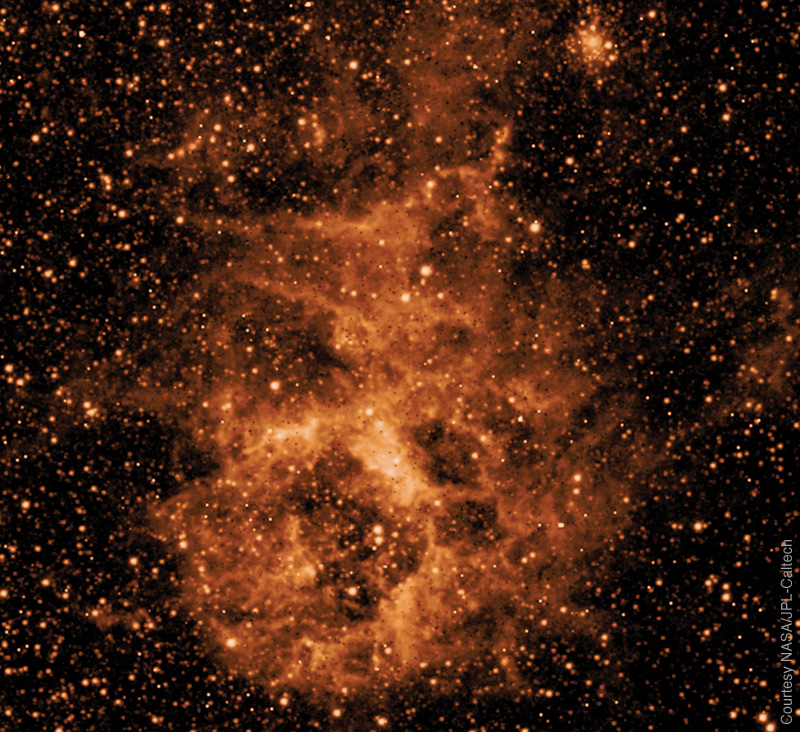
The $488 million NASA mission is creating the world’s most complete sky survey to better explain how the universe evolved and galaxies formed, and to search interstellar gas for water ice and organic molecules, the key ingredients for life. “We are finding water everywhere,” Korngut says.
Having launched to low-Earth orbit last March, the 1,100-pound spacecraft is producing 102 maps in 102 infrared wavelengths every six months. After two years, the mission team will have enough data to create a 3D map of the entire night sky. By mapping how matter dispersed after the Big Bang, they hope to improve scientists’ understanding of the physics driving the universe’s expansion to its current flat, weblike structure. Onboard spectroscopy instruments are helping analyze the chemical compositions of stellar objects and their distances between one another. A key part of the project is measuring the extragalactic background light—the total cumulative radiation produced in the universe through cosmic time, which should account for galaxies beyond the detection threshold. Depending on what they find, scientists will make more targeted observations with the Hubble and James Webb space telescopes, for which other Penn alumni played key roles [“Profiles,” Sep|Oct 2019 and Nov|Dec 2021]. “We’re measuring the entire forest. James Webb is counting pinecones,” he says.

Meanwhile, mission data—which Korngut is helping to compile and analyze—is already pouring into a public archive for anyone to use, providing fruitful findings not only for the SPHEREx researchers, but other branches of science. “There’s so much in this rich data set,” says Korngut. “The first exposure we took with SPHEREx had a signal that we didn’t expect to see arising from helium emission in the upper atmosphere. There’s a whole other branch of science, heliophysics, that is now using that data.”
Yet if you’d have asked the teenage Korngut what he was destined to be, he’d have told you a musician.
Growing up in Brooklyn, Korngut was a multi-instrumentalist who focused on jazz saxophone at the Fiorello H. LaGuardia High School of Music & Art and Performing Arts. But he still managed to tackle AP Physics. He straddled the two paths well into his time at Oberlin College, when his talents and preference for a more stable career tilted him toward physics and his particular interest in the history and evolution of the universe. The absence of a graduate school enabled Korngut to do his own research in solid-state physics as an undergrad. “I loved working in the laboratory,” he says. “It was very important for me to get to build stuff and actually make measurements and do tests.”
After graduating with a physics degree in 2005, he spent two years at the National Radio Astronomy Observatory’s Green Bank Observatory in West Virginia, working on a new receiver antenna to study how massive clusters of galaxies interact with the cosmic microwave background, the relic radiation that is thought to have formed a few hundred thousand years after the Big Bang. The project lead was Mark Devlin, Penn’s Reese W. Flower Professor of Astronomy and Astrophysics. The experience led Korngut to pursue a PhD in physics at Penn, with Devlin as his advisor.
At Penn, Korngut relished the department’s close-knit community of students who often lunched with professors. “Mark Devlin’s lab was absolutely the place for me,” he says. “That culture of experimental cosmology, where you’re after some of the most profound things we can measure in physics. But to get at them, you have to build experiments. So, you get to play with lots of cool toys, then go to crazy places around the world to implement them.” (Korngut’s career has included scientific collaborations in Asia and field work in Chile’s Atacama Desert.)
Devlin remembers Korngut as enthusiastic and hard working. “Phil was one of these multitalented students,” he says. “He played the banjo and was always a fun guy to have around. He was very excited about the work and very good at it. He’s a prime example of a great Penn student who has gone on to do great things.”
From Penn, Korngut headed to the Jet Propulsion Laboratory in Pasadena, California, for a NASA postdoctoral fellowship. There, he developed suborbital rockets that carried research instruments for 10-minute spaceflights to study the extragalactic background light. Remaining a JPL affiliate, he continued that research at Caltech with a second postdoc that led to positions as staff and research scientist.
“We were making real measurements with just 10 minutes in space,” he says. “But we thought that if we could build a dedicated satellite that was in space for years and optimized specifically to get at these signals, we could learn so much more.” They began formulating the concept for SPHEREx in 2012, which NASA finally approved in 2019.
Korngut oversaw the lab that designed, built, tested, and calibrated the instruments, made them resilient enough to weather launch vibrations, radiation, and –380°F temperatures, and integrated them into the spacecraft. But there was one unexpected biological hurdle. “We were deep in the design phase and starting to prototype things when COVID-19 hit,” he says. Getting through the pandemic without falling behind was one of the biggest challenges, alongside negotiating between mechanical, thermal, optical, structural, and weight constraints.
“We really came up with some creative solutions,” he says. “People don’t often think of physics as a field where creativity is encouraged, but it absolutely is, whether it’s designing an experiment, the aesthetics of presenting figures, or giving presentations. When you give lectures, it’s a performance.”
Which harks back to his other passion. Korngut continued playing music—mostly banjo, dobro, and guitar—in bluegrass and American folk bands in Philadelphia during grad school, and later around Hollywood before settling down. “I still play for my two-year-old daughter,” he says.
“My time at Penn was invaluable to my training as a scientist, and got me to where I am now, which really is my dream job,” Korngut adds. “I remember having a moment in grad school, sitting in that lab, and thinking about what I wanted to do later on. And I really thought, Man, what I wanna do is to build an astrophysics mission at NASA for cosmology. And that’s what I ended up doing.”
—Susan Karlin C’85